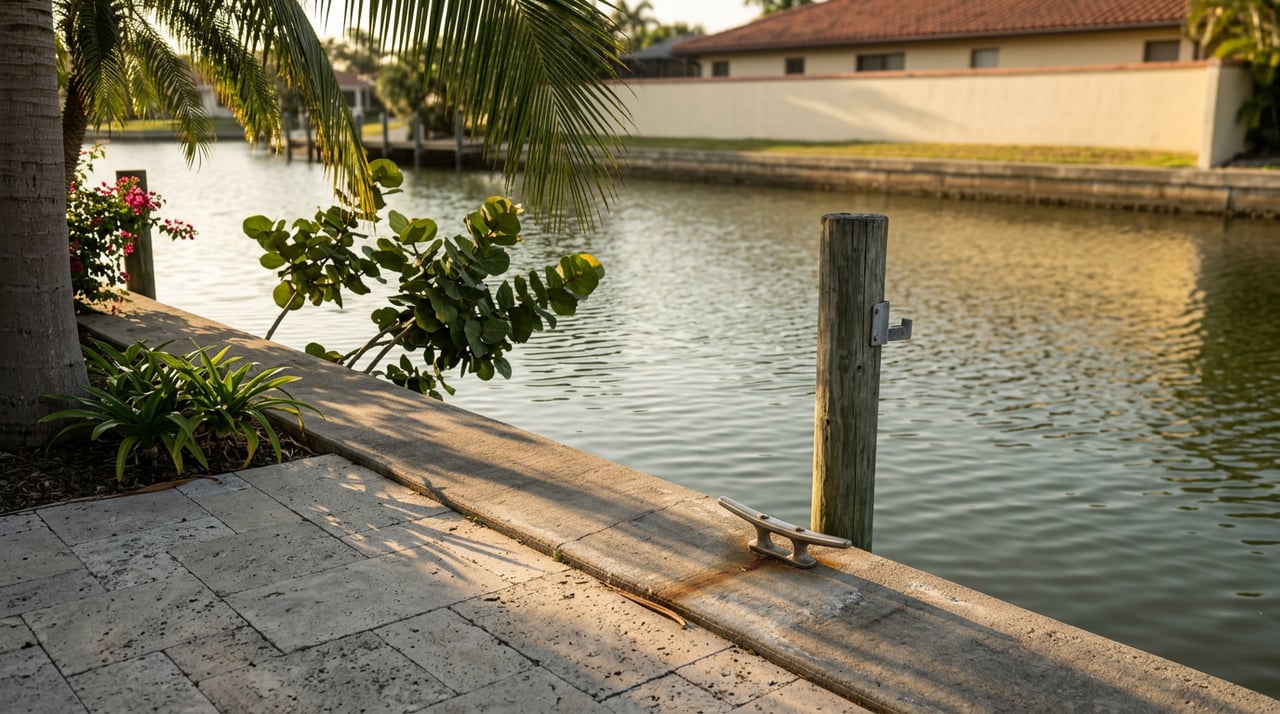
A buyer finds a canal-front house in Rio Vista, loves the dock, loves the light, and goes under contract at asking. Three weeks later the marine survey comes back: the seawall has cracked panels, visible tieback corrosion, and enough deterioration that any repair will legally count as more than half the wall. That single number, more than half, is not a contractor's opinion. It is the trigger point written into Fort Lauderdale's own seawall ordinance, and it turns a routine repair into a full compliance rebuild at current code. The buyer now owns a negotiation, not a house.
This is the part of Fort Lauderdale waterfront shopping that never shows up in a listing description. Everyone comparing Rio Vista to Coral Ridge to Las Olas Isles is comparing view, dock length, and square footage. Almost nobody is comparing the one variable that actually explains why two similarly priced canal homes a few blocks apart can carry wildly different long-term cost, and it has nothing to do with the kitchen.
The clock nobody puts in the listing description
Fort Lauderdale has committed to raising seawall standards on a fixed timeline. Under the city's current regulations, seawalls need to reach 4 feet above sea level by 2035 and 5 feet by 2050. The rule does not wait for a homeowner to volunteer for the upgrade. Once a permitted repair exceeds 50 percent of the existing wall, the compliant height becomes mandatory immediately, on that owner's dime, on that owner's schedule.
That single clause is why a seawall inspection matters more on a Fort Lauderdale waterfront purchase than almost anywhere else in the state. A wall that looks stable today but sits at 60 percent deterioration is a wall where the next storm, the next tieback failure, or the next routine repair could cross the threshold and convert a five figure fix into a six figure rebuild.
The cost estimates for that height increase vary depending on who is doing the estimating, and the gap is worth understanding rather than smoothing over. City planning studies have used an average closer to $120 per linear foot to raise an existing wall's height. Brokerage-side estimates from agents who have walked clients through the process put the real number at $500 to $1,000 per linear foot. The difference is not a contradiction so much as two different questions answered honestly. The planning figure is a citywide average across simple retrofits. The higher figure reflects what an individual contractor actually quotes once site access, tie-back replacement, and permitting delays are priced into a specific property. A buyer should expect something closer to the higher range unless an engineer says otherwise.
Full seawall replacement, separate from a height retrofit, runs on its own scale. Vinyl sheet pile installs for roughly $175 to $275 per linear foot, concrete panel systems run $250 to $400 per linear foot, and both figures already include the cap. Add engineering fees of $2,000 to $5,000 and permitting costs of $800 to $3,000, and a full replacement on a typical 75 to 150 foot residential lot lands somewhere between $30,000 and $100,000 before a single finish is chosen inside the house. A pre-purchase seawall survey costs $1,500 to $3,000 and is the cheapest insurance a waterfront buyer will ever purchase.
What the median actually contains
The published numbers for Fort Lauderdale's marquee waterfront neighborhoods look straightforward until you set them next to each other.
| Neighborhood | Reported price point | Character |
|---|---|---|
| Harbor Beach | Entry prices frequently exceed $3 million | Gated, private beach access, deepwater dockage for large yachts |
| Rio Vista | Spring 2026 median between $2.6 million and $3.0 million | Historic platted district, wide deepwater canals, no fixed bridges to the ocean |
| Las Olas Isles | Median sale price near $5.0 million, up 14.7 percent year over year as of mid-2026 | Finger islands, walkable to Las Olas Boulevard dining |
| Coral Ridge | Median around $1.6 million as of early 2026 | Wide navigable canals, deepwater finger islands |
| Victoria Park | Median around $1.1 million in 2026 | No mandatory HOA, walkable, canal-front pockets |
Set Las Olas Isles and Rio Vista side by side and the story stops being a simple story about prestige. In indexed sale data reported in July 2026, Las Olas Isles posted a 14.7 percent year over year gain in its median sale price, while Rio Vista showed a 10.8 percent year over year decline over the same window, even though Rio Vista carries the older pedigree and, on paper, the more storied address. As of March 2026, a citywide search of active waterfront listings showed a median asking price around $655,000 across more than 1,300 properties, a number that has almost nothing to do with any of the enclaves above. Waterfront is not one market in Fort Lauderdale. It is several markets wearing the same label, and the thing quietly separating them is condition and infrastructure age, not location alone.
That divergence is the finding worth sitting with. A buyer comparing two waterfront addresses by median price per square foot is comparing two numbers that do not measure the same risk. One property might sit behind a wall replaced within the last decade. The other might sit behind a wall built before the current code existed at all, still legal today, still someone's liability the moment a contractor opens it up.
Freshwater, saltwater, and the invisible second line item
Not every Fort Lauderdale canal behaves the same way physically, and that difference shows up in the carrying cost long before it shows up in the sale price. Freshwater canal properties, common on the interior side of several neighborhoods, generally sell for less than tidal saltwater canal homes with direct Intracoastal access. They also carry lower flood insurance and skip the salt corrosion that steadily degrades docks, boat lifts, and seawall hardware on the saltwater side. For a buyer who wants a water view and a private dock without the full marine lifestyle price tag, that freshwater discount is real value, not a compromise.
The flood zone overlay adds a second invisible line. Flood insurance alone on a canal-front home in an AE zone typically runs $4,000 to $12,000 a year depending on elevation and prior claims. Combine that with windstorm coverage and total insurance on a waterfront property often lands between $12,000 and $25,000 annually. A comparable non-waterfront home in an X zone might carry $2,000 to $4,000 in flood premium, purchased voluntarily rather than required by the lender. Two houses in the same neighborhood, similar square footage, similar finish level, can differ by $8,000 to $15,000 a year in carrying cost purely on elevation and flood zone designation. None of that shows up in the list price. All of it shows up on the first insurance renewal.
Florida law now requires sellers to disclose prior flooding, any insurance claims filed for flood damage, and any federal disaster assistance received on the property, part of a disclosure requirement that took effect after years of Florida being one of the few states without one. Ask for that disclosure early. It tells a buyer more about a property's real flood history than a flood zone letter ever will.
The wall holding back the canal is treated by most homeowners policies as a land improvement, similar to a fence. Gradual deterioration is typically excluded. Sudden storm damage may be covered. The distinction between those two categories is where most waterfront owners get an unpleasant surprise.
What to actually ask before comparing two listings
A buyer serious about a Fort Lauderdale waterfront property benefits from treating the comparison as a cost problem rather than a view problem. Before comparing two addresses on price alone, it is worth confirming:
- The seawall's age, material, and whether any repair on record has already approached the 50 percent threshold that triggers mandatory height compliance
- Permit history for the dock and seawall on file with the city or Broward County, since unpermitted structures create title and liability issues at resale
- Whether the property sits on a saltwater tidal canal or a freshwater canal, which changes both insurance cost and long-term maintenance
- The FEMA flood zone designation and, ideally, a current elevation certificate rather than relying on the zone letter alone
- Whether the enclave charges a waterfront assessment separate from standard HOA dues, a structure used in communities including Isla Bahia and Rio Vista Isles
- Whether the lot is a point lot, where two waterways meet, which commands a premium for multi-directional water views but often faces greater wake and tidal exposure on the seawall
The comparison that actually matters
Two Fort Lauderdale waterfront homes can list at nearly the same price and represent completely different financial positions once the seawall, the flood zone, and the canal type are accounted for. The 2035 and 2050 compliance dates are not abstract policy details. They are a countdown running quietly behind every canal-front listing in the city, and the properties furthest from that clock, recently inspected, recently replaced, correctly permitted, are worth more than a comparable home sitting on a wall nobody has looked at since the 1990s, regardless of what the listing price says today.
If you are comparing Fort Lauderdale waterfront neighborhoods and want the seawall history, flood zone exposure, and canal type factored into the comparison before you write an offer, Santiago Ferreira can walk through the specific enclave and specific dock with you. Schedule a private consultation before the next listing catches your eye.
Frequently asked questions
Does homeowners insurance cover seawall repair in Florida? Typically not for gradual deterioration. Standard policies treat the seawall as a land improvement rather than a covered structure, and sudden storm damage is the more likely scenario where coverage applies. A property-level check with your carrier before closing is worth the phone call.
What is a point lot, and why does it cost more? A point lot sits where two waterways meet, giving water views on multiple sides and typically better natural light. Neighborhoods like Isla Bahia and Rio Vista Isles are known for them. The tradeoff is often greater tidal and wake exposure on the seawall itself, which can shorten the interval between inspections.